Ep 81. Healing Your Body Image is Healthy as F*ck
Jan 19, 2026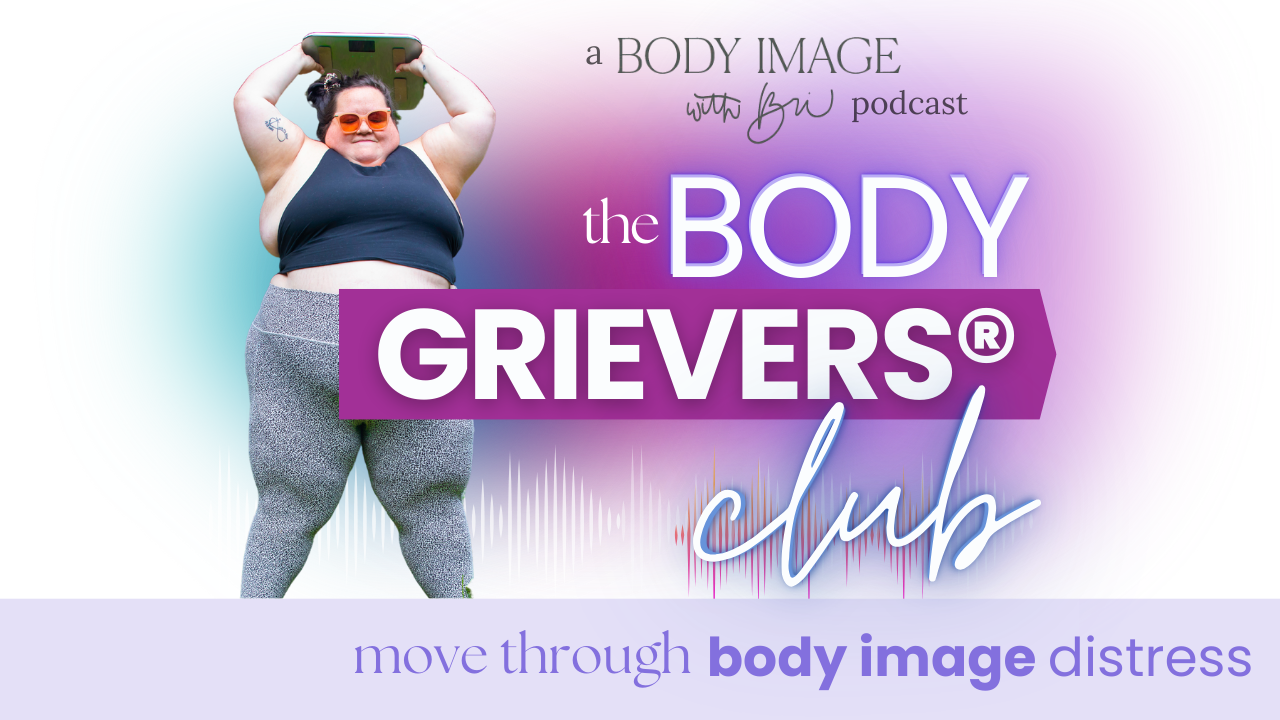
In this episode of The Body GrieversⓇ Club, Bri goes live and bears all about the complexities of body image and the radical notion of body acceptance. As a body image coach, she challenges societal norms and misconceptions around health and body size, dives deep into the emotional and psychological toll of weight discrimination, and introduces the concept of 'body grief.' The discussion includes common fears that hinder radical body acceptance and highlights the importance of grieving the loss associated with societal body standards. Bri also explores the transition from pursuing weight loss for social privilege to embracing one's body through a lens of compassion and dignity. Join Bri on your body grief journey – you are not alone in this transformative process.
TIMESTAMPS
01:55 Challenging Conventional Health Beliefs
03:33 The Reality of Body Image and Health
04:25 Common Hurdles to Radical Body Acceptance
05:15 Litmus Tests for True Health Motivation
06:34 Personal Journey and Professional Insights
07:57 Understanding Body Positivity and Fat Phobia
08:41 Shocking Statistics on Body Image and Health
11:41 The Turning Point: Personal Therapy Experience
16:54 The Concept of Body Grief
22:24 The Path to Body Liberation
31:08 Navigating the In-Between: Body Grief and Healing
35:46 Conclusion: Starting with Body Grief
WANT MORE OF BRI?
*Instagram: @bodyimagewithbri
*Website: https://bodyimagewithbri.com/
*Bri’s Free Resource: 7-Step Guide to Shift Body Grief to Radical Body Acceptance
TRANSCRIPT:
Hi, and welcome back to another episode of The Body Grievers Club. Today’s episode is a little different. I’ve written a blog post, and this audio is the companion to that post. I’ll be reading it aloud here.
If you’re joining me live on Instagram, I’ll hang out with you and we’ll answer questions at the end. If you’re listening on the podcast or reading the blog, feel free to drop your questions in the comments. Let’s dive in.
As a body image coach, here’s what I would tell you if I wasn’t afraid to hurt your feelings.
If your health is conditioned on the size of your body, that isn’t health — that’s the privilege of body hierarchy. If you are more afraid of being seen as unhealthy than actually being unhealthy, what you fear is being seen as a fat stereotype, not sickness. Those are two very different problems.
It is often safer to hire the body-positive trainer or intuitive eating RD than it is to hire a body image coach. The first gives you actionable steps while quietly allowing you to hope that, if you do enough, your body might still change. The second forces you into uncritical observation. Why does shrinking my body matter so much to me? Why am I trying to beat my body into submission?
You can do all of the so-called health-promoting behaviors and your body might still fail you. If that truth stings with shame, what you want more than health is body obedience.
You’ve been taught to believe that weight loss guarantees body acceptance. The truth is that weight loss gives you more social privilege, better access to medical care, and a lot of unsolicited praise. But the body hatred didn’t disappear — it just rebranded itself as wellness.
You do not need to be healthy to stop trying to hate your body into submission. Healing your body image is actually one of the healthiest things you can do. And if this pissed you off and made you curious at the same time, good. That’s who I wrote this for.
Healing your body image is the healthiest thing you can do for yourself.
There are three common hurdles that keep people stuck when they encounter radical body acceptance.
The first is fear of judgment — what will other people think of me?
The second is fear of discomfort — what if this feels unbearable?
The third is fear of losing health — but what if I become unhealthy?
For most people on a weight loss journey, health is the stated motivation. I believe many people genuinely think they are pursuing health. But here’s a simple litmus test: if the behaviors you’re doing to “improve your health” did not guarantee weight loss, would you continue doing them?
If the answer is no, then health isn’t your only motivator — and that’s okay. But we can’t accurately solve a problem we aren’t willing to name.
Another litmus test: how long can you realistically sustain the behaviors you’re engaging in? I can say with confidence that the health-promoting behaviors I engage in are sustainable — forever. The tradeoff is that I don’t get to control my body size. You cannot have peace with food and body while also trying to micromanage them.
I’m not a doctor, and nothing I say or write should replace medical advice. I am, however, a trained mental health counselor with over ten years in eating disorder recovery. I know it’s more appealing to present you with neat research packets showing how weight and health are correlated but not causative. But as I tell my clients: if you need to arm yourself with research for a conversation, you’ve already lost.
My approach won’t be for everyone. It will probably piss you off. And wherever you are in your body image journey, you are welcome here.
Here’s the buy-in required for my work to meaningfully impact you.
First, you need to understand what body image is — and what it isn’t. Body image is not just liking what you see in the mirror. That’s only one piece of it.
Second, you need to understand what body positivity is — and what it was never meant to be. Body positivity was not about loving your body. It was a social justice movement started in the 1960s by fat Black queer women demanding equal treatment, dignity, and access to medical care. That fight is still ongoing.
Fatphobia is alive — and it is deadly.
Only six U.S. cities and one state have laws protecting against height and weight discrimination. Women classified as “obese” earn about 5% less than women considered “normal weight.” While bias toward race, skin tone, and sexual orientation has decreased in some studies, weight bias has increased.
Fat people are widely perceived as unattractive, weak-willed, lazy, and morally flawed. Thirty million Americans have eating disorders. Thirty million Americans have diabetes. Which one did your doctor warn you about?
Less than 6% of people with eating disorders are medically underweight. Every 52 minutes, someone dies from an eating disorder. Nearly half of Americans say they would give up a year of their life to avoid being fat. Fifteen percent would give up ten years or more.
Ninety-one percent of women are unhappy with their bodies, despite only 5% naturally having the body type celebrated in media. The average women’s pants size in the U.S. is between 16 and 18 — considered plus-size. Eighty percent of ten-year-old girls have already been on a diet, reporting they fear becoming fat more than cancer, war, or losing their parents.
If you care about health, you must care about eating disorders, body image, weight discrimination, and inclusive healthcare. This became my why.
My approach comes from treating my most disordered clients — and myself.
In 2014, while working as an eating disorder therapist, I believed the whitewashed version of body positivity, yet I couldn’t believe I could be healthy in a fat body. I worried constantly about food, weight, and control. My therapist once asked me, “How much weight do you need to lose to be healthy?”
That question broke something open.
I realized I couldn’t define health without weight. What I really wanted was the protection of being smaller — protection from judgment, from dismissal, from bias. My therapist helped me sit in that dissonance and asked: If you never lost another pound, why would that be so bad?
The fears poured out — fear of being unlovable, unprofessional, disappointing everyone. I believed weight loss was proof of worth, discipline, and deservingness.
What I was feeling wasn’t failure. It was grief.
Body grief is rarely named. It’s the grief of recognizing yourself in photos. The fear of chairs, seatbelts, doctors’ offices, dating apps. The constant checking, measuring, bracing for judgment. Diet culture calls this “health motivation.” I call it chronic heartbreak.
After years of chasing control, I chose the path less traveled. I chose to grieve the body I thought I needed in order to live. I grieved the belief that joy, love, sex, success, and kindness were conditional on becoming smaller.
And I was wrong about one thing: I thought I’d never feel at home in my body.
Today, I am more at home in myself than I’ve ever been.
Liberation didn’t come from loving my body. It came from no longer requiring my body to earn my humanity.
Imagine diet culture as a cliff promising praise, success, love, and health — with endless rules and constant fear of failure. Across from it is another cliff: body liberation. No body hierarchy. No moral value assigned to size. Health pursued without punishment.
Between them is a dark chasm — body grief.
I’m not asking you to leap. I’m asking you to climb down into the in-between. To sit with the grief instead of running from it. You can always climb back up if you want.
Body grief is painful. It exposes fears you’ve never said out loud. But it also makes room for joy, connection, and freedom. We move at the pace of your nervous system. We pause when needed. This is how trust is built.
Grieving your body will not always feel devastating. Food and body noise does not have to hum in the background forever. There is a world where food becomes memory and nourishment again. A world where your body doesn’t steal your mental energy.
You don’t need belief to start healing. You don’t need body love. You don’t need radical acceptance.
You just need willingness.
Start by saying the quiet part out loud. That alone won’t heal everything — but it’s healthy as fuck.
You don’t need to begin with liberation.
Start with body grief.
Welcome to The Body Grievers Club.
